


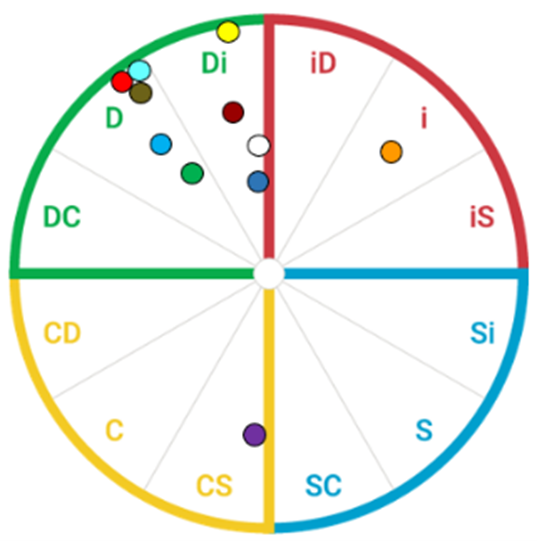
 I was recently working with an Executive Board of a large global organisation and their “DiSC” map had a very high degree of D style. In fact, of the 11 members of the team, 9 were D! I’ve always hammered home that no one style makes the best leader. To prove this whenever I’m asked the question I get people to think of the best leader they’ve worked for and then consider their DiSC style. Their responses invariably are a range of DiSC styles proving my argument (although what is a common theme is that all these “best” leaders were able to adapt their style to the needs of the person or situation they were working with).
However, last week’s experience prompted me to look back at all the senior leadership teams I’ve worked with to check the style distribution. Indeed, there was a high degree of D style. I then dived into the Everything DiSC manual published by Wiley and especially the chapter “DiSC Styles and Occupational Membership”. I discovered that “DiSC style is not a powerful predictor of occupational choice, satisfaction or tenure” (hence be careful of over-using it in a recruitment process). However, as task preferences are conceptually related to DiSC styles, we do see that certain styles are represented more frequently within certain types of roles. For example, according to Wiley’s research, if you look at Executives, Di is the highest mean scale and D is the second highest.
So, I then started considering why. We know senior leadership might require promoting action and directing others so an element of a D approach would help. However, senior leaders also need to inspire, create a vision, be strategic and future-thinking, listen and engage others, encourage teamwork, and have an enquiring and challenging mind amongst other qualities. None of these may be especially natural for someone who relies too heavily on a D style.
Is there a degree of truth in the hypothesis that senior leaders climb to the top because of their competitiveness , ego and drive or does the organisation select these people because they believe this is what is needed to lead an organisation? I also suspect that once a D culture has been established at the top it becomes self-recruiting and/or people adapt their style in that direction because they feel that is what is needed or are required to adopt to “fit-in”.
What I am sure of is that from my experience and all my colleagues at The Fruitful Group, is that over-relying on one style can have significant detrimental consequences for any team including a leadership team. This was discussed and recognised by the executive team I was working with recently. They explored their lack of cognitive diversity when making decisions, the fact that they had an element of short-termism and focus on the now not the future. They were also aware they weren’t always slowing down to explore the evidence and data and indeed consulting and engaging the wider organisation. A three-hour Everything DiSC team coaching session generated a practical and realistic set of actions that ensured they would use a more diverse approach to their work and reap the benefits.
I also wonder if there might be less pressure to “fit-in” to a particular DiSC style culture and therefore bring their true self to work. Wouldn’t that be wonderful. Great leaders come in all shapes, sizes, and DiSC styles…
Our Recommended Products
 |  |  |
George Blakeway is the Managing Director of the Fruitful Group – a Leadership and Team Performance business that helps individuals and teams be at their best. We also develop other Learning & Development professionals and give them the tools to do this including our new Team Coaching tool. For more information about us and our solutions visit our site here.
